
Strength training for beginners: frequency, learning movements and gradual progress
Published on
What general strengthening targets mean, how to obtain instruction and why progress is not simply adding weight at every session: a guide to getting started.
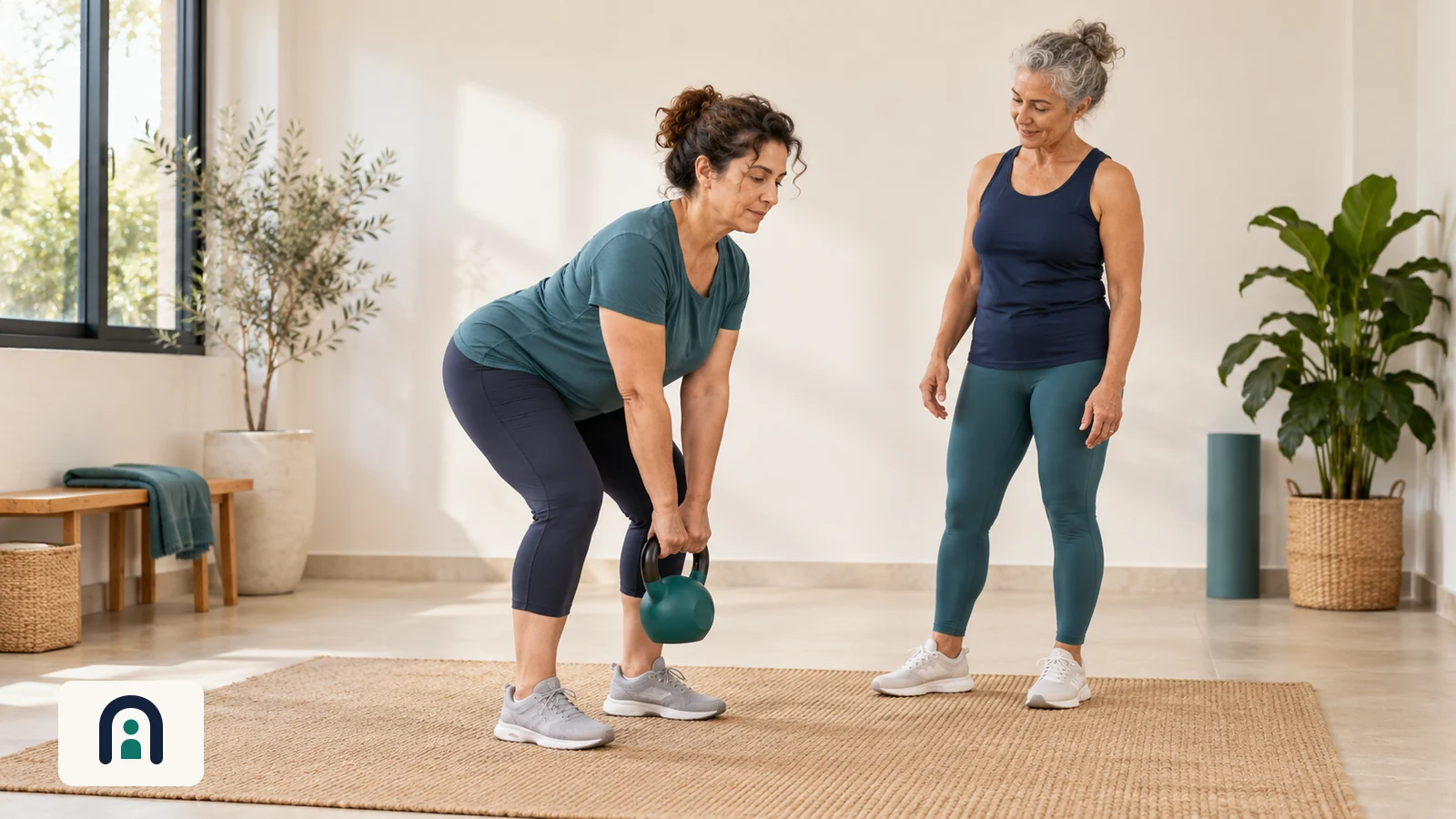
Starting strength training means learning movements, choosing a manageable load and progressing gradually. Public health recommendations for adults include strengthening the major muscle groups on at least two days a week, but that is a general target. It does not determine the exercises, weights or recovery periods suitable for every beginner.
Your first step need not be finding the most complicated programme. It is more useful to understand what you are doing, how feedback works and what will let you return for the next session. Home equipment, resistance bands and body weight can all feature in strength training. The most impressive equipment in the room is not necessarily right for your starting point.
What counts as strength training?
Strength training involves working against resistance, which can come from a machine, weight, band or your own body weight. The updated ACSM guidance describes different ways to perform resistance training; the choice need not be limited to one equipment type. Suitability depends on performance, the exercise's purpose and how it can be adapted.
An exercise name does not convey its full difficulty. The same movement pattern can have different versions, support or ranges of motion. Beginners should receive an explanation of the chosen version and how to change it if it is unclear or unsuitable. You do not need to adopt the version someone beside you is performing.
Walking and aerobic activity are not identical to strengthening work, and general recommendations include both components. The guide to physical activity recommendations for adults explains how they fit together. The question is not which cancels out the other, but how to build a routine that accounts for both within your abilities.
Frequency is a framework, not a ready-made programme
The Ministry of Health recommends that adults aged 18 to 64 include strengthening work for the major muscle groups on at least two days a week. ACSM likewise emphasises training the major muscle groups at an appropriate frequency and maintaining consistency. This does not instruct every beginner to reach the same volume or perform the same exercise sequence in their first week.
Establish what fits your timetable and how to start gradually. A programme based on unavailable hours will struggle to become routine. Ask the trainer how sessions and independent practice are planned, and what to do in a week with less time.
Do not make up missed sessions by adding an arbitrary load without understanding the programme. Instead of treating them as a debt, ask how to continue from the present point. Planning should account for what has already been done and individual suitability, not merely a number marked in a diary.
Learn the movement before chasing a number
When given a new exercise, ask its purpose and how to begin and finish it. Ask what to look for during performance and when the version needs adapting. A good explanation does not require a complete anatomy education, but should let you understand the task rather than hurriedly copy a demonstration.
During an individual session, you can ask for feedback as you practise. With a remote programme, establish beforehand how feedback is provided: whether to submit a video, to whom and when to expect a reply. Do not assume a written programme includes supervision of every workout. The comparison of training formats helps clarify the support offered.
Machines also require familiarity with adjustment and operation. Request instruction appropriate to your facility. You need not guess from the previous user's seat position or a video showing different equipment. If unsure, stop and ask before starting.
Progress is more than adding weight
Progress may mean understanding an exercise better, performing it more consistently or managing the planned routine. Changes in load should relate to your goal and response to training. There is no universal formula for adding a fixed weight each session regardless of performance or circumstances.
ACSM emphasises consistent resistance training and says training to failure is not essential for benefit. That does not mean any light effort is sufficient for every goal; it means maximum effort need not become the symbol of a successful workout. Beginners should understand what has been set for them and why.
Record which exercises and versions you performed and what was clear or difficult if useful. The record should support discussion with the instructor, not become a competition with others. Before a change, ask what is changing and what remains constant. That helps you understand the process instead of changing programmes whenever a new video appears.
Consider recovery within your whole routine
No fixed number of hours lets everyone know with certainty that they have recovered from every workout. Planning should consider experience, load and individual circumstances. If you receive a programme, ask how time between sessions is planned and what to do when difficulties disrupt ordinary life.
Do not use pain as the sole measure of success or try to diagnose symptoms through an online guide. Sharp, unusual or unexplained pain requires stopping and appropriate assessment. Symptoms such as chest pain, fainting or unusual shortness of breath call for medical help according to severity, not an attempt to finish the workout.
Tell the professional through an appropriate channel about relevant illness, injury, surgery or medical instructions. Do not assume a programme intended for healthy adults automatically suits you. Equally, a general description of age or goals cannot establish your limitations. Adaptation needs to be individual.
Choose equipment and a setting around your needs
A gym membership is not the only starting point, but home training does not suit every need either. Ask what equipment your particular programme requires, what can be adapted to the available space and how instruction works. Buying equipment before defining its use may create expense without resolving how you will learn.
For a gym, check accessibility, hours and instruction rules. At home, check that space is suitable and equipment can be used as instructed. Do not copy makeshift arrangements from unfamiliar sources or assume every household object is suitable for loading. The setting should enable clear, consistent practice rather than accumulate accessories.
Find candidates in the personal trainer directory and ask about qualifications and working methods. Check introductory sessions, included support and how equipment use is taught. A provider offering a beginner programme should explain how it fits your starting point, not merely show an existing example.
Plan the first week without trying to solve the whole year
Imagine someone wants to start but does not yet know the facility or equipment. Initially, they can investigate instruction options, attendance times and service structure. This illustrates organisation, not an exercise programme or prescribed session count. What to perform is chosen together after getting acquainted.
Prepare questions: how will understanding of an exercise be checked, what happens if it is unsuitable and how should difficulties between workouts be reported? Establish who updates the programme. There is no need to run several programmes from different sources and try to combine them without understanding their total demands.
After the introductory period, consider whether a repeatable routine has developed. Do you know what to do, can you attend and is help available? These questions come before comparisons of weights or other people's figures. They provide a basis for discussing the next stage and necessary adjustments.
What to take from general guidance
The ACSM resistance training guidance (opens in a new tab) puts consistency and work on the major muscle groups at its centre. It helps show that strength training is not reserved for competitive athletes or one equipment type. It does not replace individual choices about load, exercises and adaptations.
Ask the professional how the guidance translates to your circumstances. If the answer rests only on what everyone does, part of the enquiry remains unanswered. A reasonable start need not look impressive. It should be understandable, feasible and appropriate, with a clear way to change it as experience grows.
To make reviews more useful, distinguish what you performed from what you understood. A note saying the exercise is still unclear provides different information from a repetition count. You do not need to record every sensation or film every workout; establish which information your agreed review actually requires.
When considering a change, ask which detail is changing: version, resistance, volume or amount of instruction. If everything changes together without explanation, it becomes difficult to know what should improve and what to report. This is not a technical planning formula, but a way to maintain clear communication within an individual programme.
Ask how to use the programme while travelling or during an unusual week. Do not try to recreate a workout in an unfamiliar facility solely to preserve a diary tick. Checking an alternative or postponement keeps you within an understood arrangement instead of replacing it with improvisation.
General information cannot replace diagnosis, medical advice or individual fitness and nutrition guidance. Consult a qualified professional for medical conditions or symptoms.
Further reading

Exercising in an Israeli summer: heat stress, drinking and knowing when to stop
Plan exercise around heat and humidity, access to water and cooling, personal health instructions and warning signs that require stopping.

Exercise during pregnancy and after birth: guidance, adaptations and warning signs
Understand general pregnancy exercise guidance, recovery after birth, warning signs and questions to discuss before choosing an activity setting.

Exercise after 60: strength, balance and choosing the right setting
Choose activity and professional support after sixty, understand guidance for people aged 65 and over, and check what fits your abilities and routine.