
Exercising in an Israeli summer: heat stress, drinking and knowing when to stop
Published on
How to plan activity in heat and humidity, why no single threshold or drinking amount suits everyone, and what to check before setting out.
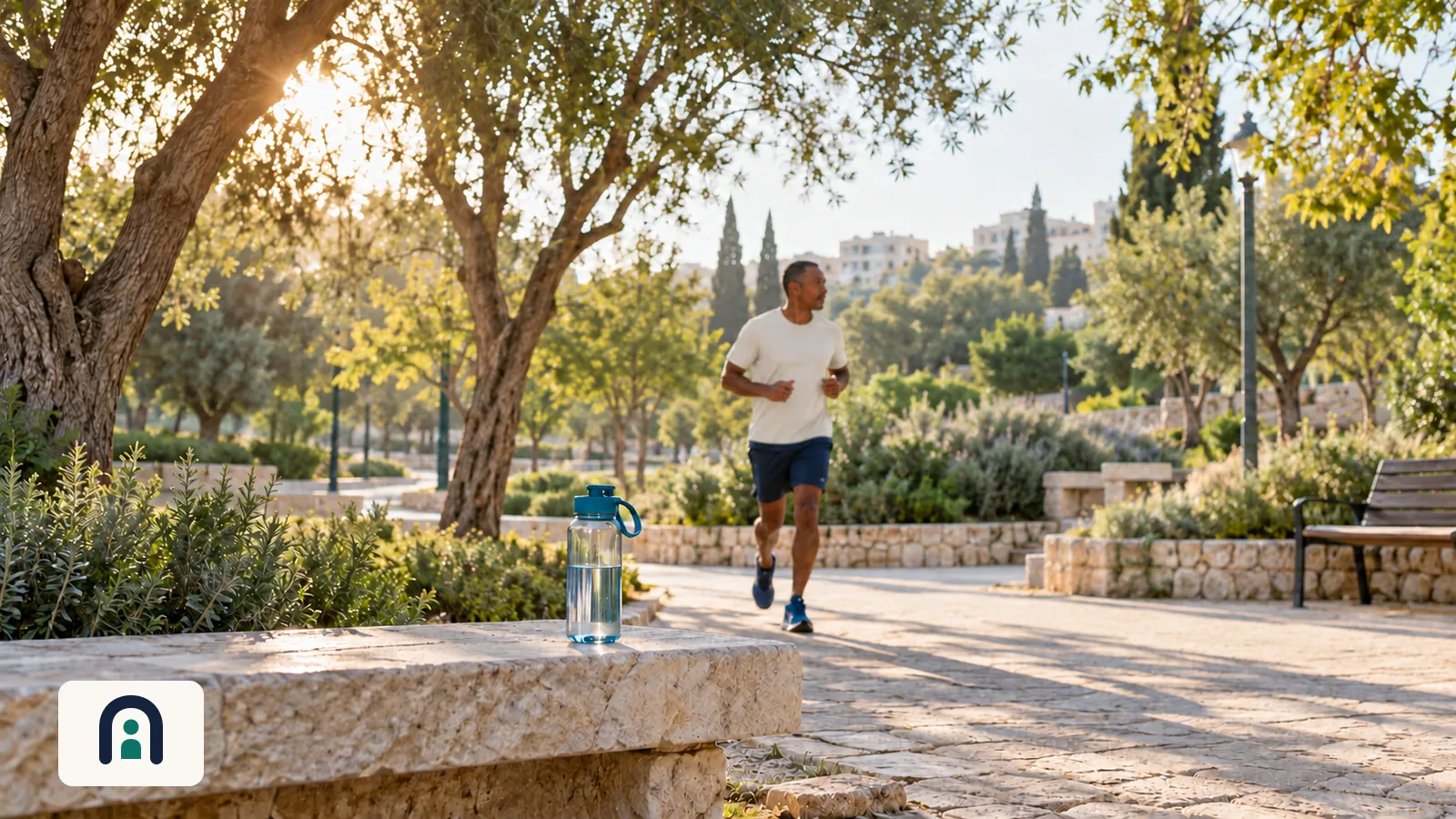
In an Israeli summer, workout planning starts with environmental conditions, not only exercises. Heat and humidity can turn familiar activity into an effort that needs changing or cancelling. When the Ministry of Health advises avoiding exertion in extreme weather, a scheduled workout should not be treated as an obligation to complete in any conditions.
No single temperature guarantees safety for every person and activity, and no drinking amount suits everyone. Effort type and duration, humidity, sun exposure, health and access to a cool place all matter. This guide offers a way to consider the decision before leaving and explains where general information is insufficient.
Check conditions for the activity you plan
Do not rely solely on the temperature beside your city's name. Check the forecast and heat-stress warnings for the time and route. Activity in direct sun, somewhere without an easy stopping point or without water and cooling raises different questions from a session in a cooled building.
An early or late hour is not automatic clearance to go out. Heat and humidity may remain demanding; check actual conditions. If unsuitable, change the setting or postpone. You do not need to invent a personal threshold above which cancellation is allowed.
With an instructor, establish who checks conditions and what alternative exists. Independently, consider the return journey too. A route starting near home and then moving away offers a different ability to stop from one with easy access to an appropriate place. These questions belong in planning itself.
Heat stress is not a test of fitness or willpower
Managing an activity in comfortable conditions does not guarantee identical capacity in heat. The ACSM position stand on exertional heat illness identifies environment, acclimatisation and exertion as factors to consider. It does not provide an individual protocol suitable for every person or programme.
When returning after a break or changing environments, do not automatically copy previous loads. Gradual planning and professional adaptation have a role. This guide does not prescribe acclimatisation days or daily loading because those decisions depend on the person and circumstances.
Beginners can read the beginner strength training guide and seek a setting appropriate to the season. Gradual progression matters when starting, but does not remove the need to avoid activity in extreme conditions. Fitness cannot replace assessment of the environment.
Plan drinking beforehand without a universal prescription
The Ministry of Health emphasises access to drinking water and protection from heat. For outdoor activity, know where water is available rather than relying on somewhere that may be closed. Even after locating a tap or shop, check whether it is accessible throughout the activity, not only at the start.
Drinking needs depend on circumstances and individual health. People with medical fluid restrictions or other instructions should ask their healthcare team how to manage heat. Do not turn general advice to drink into a fixed large-volume instruction, and do not change treatment independently.
A sports drink, supplement or salt does not insure against heat illness. This guide recommends no dose or product, and summer marketing is not a reason to buy one. If the activity requires specific nutritional planning, consult a suitable professional about what that particular effort needs.
Age, illness and medication may change the enquiry
The Ministry of Health notes that older adults are more vulnerable to heat illness and recommends consultation where illness or medication may increase sensitivity. This does not mean everyone in one age group has the same circumstances, but personal instructions should not be ignored.
With pregnancy, illness, difficulty managing exertion or a health change, ask your treating professional about the activity and conditions. The guide to exercise during pregnancy and after birth discusses the limits of general guidance. It does not replace discussion of a specific workout on a hot day.
Do not stop medication or alter its timing to accommodate exercise. If you suspect treatment affects heat sensitivity, ask your healthcare team. Activity planning should fit health instructions, rather than trying to adapt treatment to a workout planned without that information.
Recognise warning signs rather than waiting to finish
Weakness, headache, dizziness, nausea or feeling unusually unwell in heat requires stopping exertion and addressing the situation. Confusion, reduced alertness, collapse or deterioration requires urgent medical help. Do not use a short list to diagnose the type of heat illness yourself.
If severe heat illness is suspected, call for urgent help, stop exertion and begin cooling according to the emergency service's instructions and the situation. Do not give fluids to someone insufficiently alert to swallow safely. Do not wait until the route ends or a trainer replies to a message.
Sweating or its absence cannot rule out serious illness. If someone becomes confused or collapses in heat, deciding the precise definition is unnecessary before seeking help. This guide is not a first-aid course; it aims to prevent continued exercise despite signs requiring a stop.
Arrange an alternative that does not depend on guessing
For a planned park session, ask the instructor what happens during a heat warning: moving to a suitable place, changing the time or cancelling under the agreed terms. Establish the alternative beforehand. Partial shade does not make every condition appropriate, and moving to an uncooled home does not necessarily solve the problem.
The trainer directory shows offered formats, but confirm alternatives directly. An online provider does not necessarily offer an immediate switch from every outdoor package. This is both a professional and consumer question: what is possible, what is included and how is planning updated?
Sometimes the alternative is rest or postponement, rather than preserving the same task at any cost. If you have an individual programme, ask how a missed session is handled. Do not compensate with concentrated exertion another day without checking subsequent planning.
The journey to and from the workout counts too
A session in a cooled building does not eliminate exposure on the way. Consider whether travel, walking or waiting outdoors creates additional difficulty. For people using public transport or walking to the venue, this forms part of the practical decision to leave that day.
Plan how to return to a suitable place afterwards. Do not rely on a closed vehicle left in the heat as somewhere to rest, or leave someone needing help alone while searching for a solution. Signs of distress require action according to urgency rather than simply continuing normal return arrangements.
If exercising with someone else, agree how to report difficulty and when to stop together. This does not replace medical assessment, but clear communication is better than assuming everyone will continue at their own pace to the end. Stopping should not become an argument about completing a target.
What to check before your next outing
Review forecasts and warnings, the activity, access to water and a cool place, the return route and personal instructions. Clarify uncertainties before starting. This list cannot guarantee safety, but helps prevent reliance on habit or plans made for different conditions.
Read the Ministry of Health's heat-protection information (opens in a new tab), noting that the page focuses on older adults. Obtain individual instructions from the appropriate professional. Do not transfer drinking amounts or medical rules as if they were universal for everyone exercising.
For example, a walking group might agree beforehand that outings depend on checking conditions and having an alternative. This provides neither a recommended cancellation threshold nor clearance to go out. Its organisational value is that participants need not decide at the last moment under pressure to attend. They know whom to contact and what happens if activity is cancelled.
Remain ready to change the decision after checking. An advance forecast does not guarantee unchanging conditions or how you feel. If difficulty arises, stop and address it. In summer, a good plan includes the possibility of not following it as written.
In a group, agree how changes are announced before people leave home. A message that misses someone may leave them travelling to a cancelled activity. Check the update channel and whether receipt can be confirmed, particularly if participants do not all use the same app.
If someone needs to stop, do not assume they can return alone because the route is familiar. Assess their situation and act according to urgency and medical-help instructions where needed. Group planning should accommodate the person who stops rather than wait for everyone to reach the finish.
These are organisational details, not substitutes for first-aid knowledge or assessment. They reduce unspoken assumptions about who checks, who updates and what happens when plans change. In heat, the ability to change the arrangement is part of preparation.
General information cannot replace diagnosis, medical advice or individual fitness and nutrition guidance. Consult a qualified professional for medical conditions or symptoms.
Further reading

Exercise during pregnancy and after birth: guidance, adaptations and warning signs
Understand general pregnancy exercise guidance, recovery after birth, warning signs and questions to discuss before choosing an activity setting.

Exercise after 60: strength, balance and choosing the right setting
Choose activity and professional support after sixty, understand guidance for people aged 65 and over, and check what fits your abilities and routine.
Physical activity recommendations for adults: aerobic exercise, strength and a workable routine
Understand Ministry of Health and WHO weekly activity targets, the role of strength training and how general guidance differs from a personal programme.