
Reading Israeli food labels: red and green symbols beyond the headline
Published on
What red and green symbols mean, how to compare per-100-gram and serving values, and why allergens and marketing claims require separate attention.
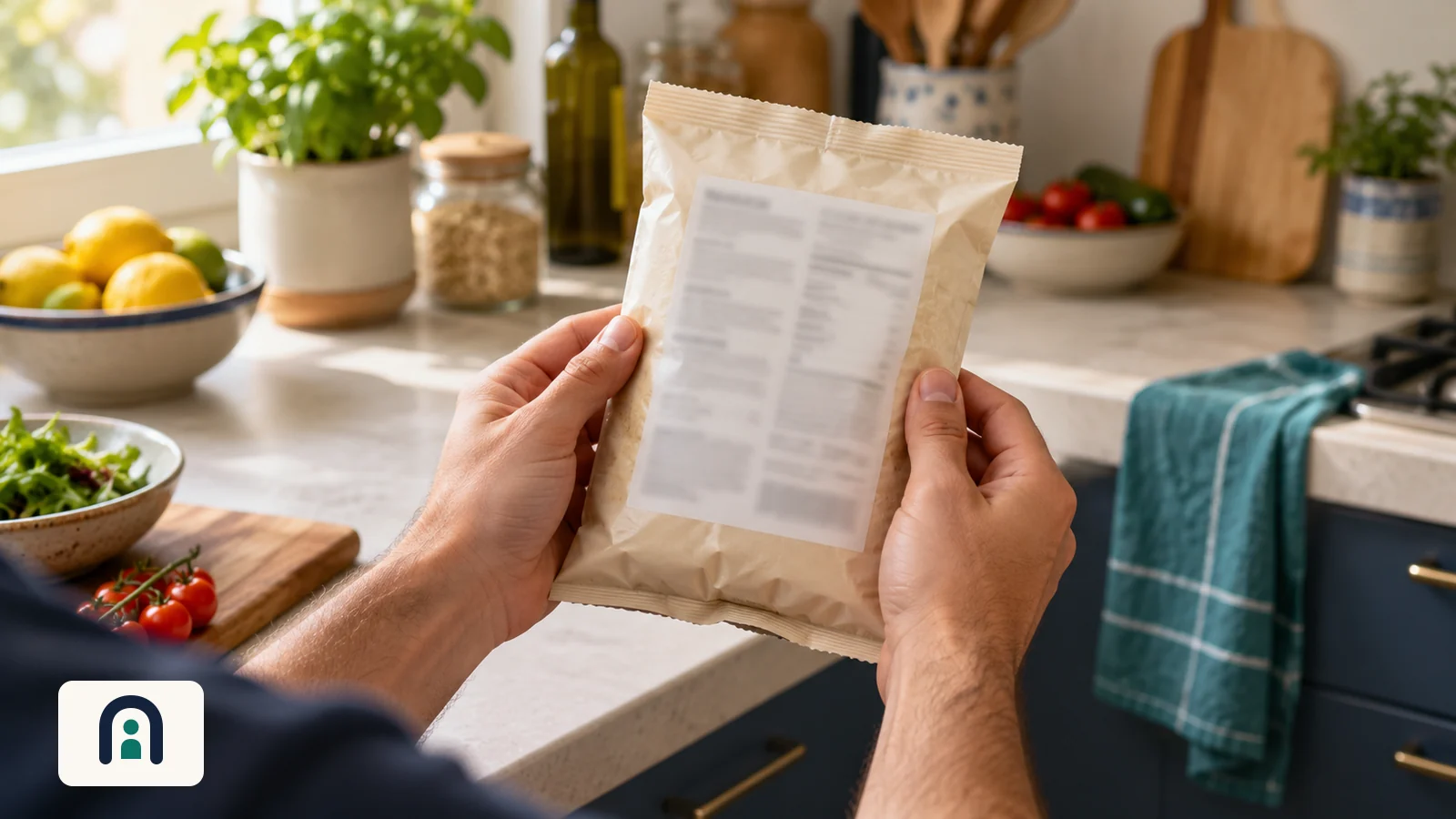
Read three things together on an Israeli food label: front-of-pack symbols, the nutrition table and the ingredients list. A red symbol warns of a high level of a particular component under labelling rules. Its absence does not establish personal suitability, while the green symbol is voluntary and available to foods meeting defined conditions.
Reading becomes useful when comparing products for the same use in the same reference unit. A pack, serving and 100 grams are different quantities. A product may appear preferable on the front simply because its prominent number describes a smaller serving. Turn the pack over and check exactly what the wording means before deciding.
What red symbols mean
Red symbols concern sodium, sugars and saturated fatty acids according to regulatory thresholds. They refer to 100 grams of solid food or 100 millilitres of liquid food under the relevant rules. They do not prescribe how much you should eat or assess an entire meal.
The Ministry of Health's publication on the phase introduced in January 2021 lists solid-food labelling thresholds of 400 milligrams of sodium, 10 grams of sugars and 4 grams of saturated fatty acids per 100 grams. For liquids, it lists 300 milligrams of sodium, 5 grams of sugars and 3 grams of saturated fatty acids per 100 millilitres. Interpret these according to product classification and regulations, which include provisions and exceptions.
Do not assume every product without a symbol sits just below the same threshold or that every missing symbol represents a breach. Product type and labelling provisions matter. The amount you eat also differs from the reference unit: the symbol is consumer information identifying a product feature, not an individual intake calculation.
Green is not simply the opposite of red
The Ministry of Health describes green labelling as voluntary for foods meeting conditions within specified food groups. It is not automatically available to every product without a red symbol. Under the guidance, food required to carry a red symbol cannot carry a green one.
Because green labelling is voluntary, its absence does not by itself exclude a food from a dietary pattern. Examine the food and relevant information. There is no basis for dividing every purchase into two absolute colour categories or ignoring foods sold in different packaging formats.
Read the official explanation of green labelling (opens in a new tab). The central distinction is mandatory labelling for certain components versus voluntary labelling under conditions. Neither replaces individual adaptation for a medical condition or an allergy enquiry.
Compare per 100 grams, then return to the amount you choose
Per-100-gram data allows comparison of similar products in a common unit. Serving data may clarify a particular use, but the stated serving is not necessarily what you eat. Check both presentations when available without mixing them.
As an arithmetic example only, a product with 8 grams of sugars per 100 grams contains 4 grams in a 50-gram quantity if evenly composed. This is not a real product example, serving recommendation or suitability judgement. It shows why the reference unit matters before interpreting a prominent number.
The same applies to packs containing several servings. Do not assume the serving figure describes the whole pack. Check weight and the stated number of servings, if given. Even after calculating, nutritional decisions depend on context and needs, not one arithmetic result.
Ingredients answer a different question
The nutrition table describes nutritional composition in defined units. The ingredients list describes what the product is made from under labelling rules. Reading one does not replace the other. A commercial name or front image may emphasise an ingredient without providing the whole picture.
For a particular feature, such as grain type or protein source, read the detail rather than only the headline. Do not infer composition from colour or product name. If a front claim is unclear, compare it with the ingredients and table or ask the manufacturer.
Allergens are separate from nutritional symbols. A green symbol or absence of red does not establish safety for someone with an allergy. Read the relevant information and follow personal instructions. If unclear, do not fill the gap by assuming similarity to another product.
Marketing wording cannot replace the data
Natural, fortified and designed for sport may attract attention, but check the precise claim and package information. You need not decide from the term alone. Changes to packaging or names do not establish that composition has changed or remained identical.
For protein-focused products, compare amounts in the same weight unit, pack size and other information. The guide to protein and food sources explains why a high figure does not automatically make a product necessary for you. Establish the need first, then compare options.
A high price is not a nutritional label either. Compare similar products by composition, use and actual cost without assuming a more expensive brand suits you better. Reading a label aims to provide clear information, not one word that removes the need to understand the purchase.
Preparation and serving affect the comparison unit
Check whether the table concerns the product as sold or prepared according to instructions. Dry or concentrated products, or those requiring added liquid, are not necessarily comparable with ready-to-eat food. Read the explanation of the product's state before comparing numbers.
If adding ingredients at home, the package table does not automatically describe the complete prepared dish. This is an arithmetic and consumer issue, not a reason to avoid cooking. Understand the figure's basis when comparing or asking a professional about a meal.
For example, comparing a ready-made stew with a dry ingredient requires knowing whether the data describe the same state. This example does not determine which is preferable. It demonstrates that accurate reading of the reference unit precedes conclusions. Seek clarification when information is missing rather than giving a number unwarranted precision.
Use labels within nutrition, not as moral scores
Symbols and tables help compare and understand features. They do not describe your entire eating pattern. The Mediterranean diet guide explains why the cumulative picture matters beyond one product. Labels are one tool within that picture.
There is no need to describe someone as eating well or badly according to a package colour. Such language adds nothing about composition, amount or need. Ask a factual question: what does it say, what does the figure refer to and how is it relevant to my choice?
If label reading becomes burdensome or involves anxiety and severe restriction, seek appropriate professional support. This guide does not encourage rigid monitoring of every detail. It offers basic understanding for choosing and asking questions without making every purchase a test.
A useful reading order in the supermarket
Identify the product and quantity, examine symbols, then read the table and ingredients according to your question. Compare with a similar product in the same unit. With medical needs, do not translate labels into personal instructions without advice. Bring a clear package photograph to a professional appointment if helpful.
For help adapting choices, consult the nutrition professionals directory and check licensing and areas of work. Bring the practical question: comparing products, understanding a serving or following existing instructions. The label then supports discussion rather than an independent medical judgement.
When a familiar product has new packaging, recheck details that matter to you. Do not assume everything is as remembered, or that redesign proves changed composition. The source is the information on the particular product you are considering.
You need not base every purchase on every line. You should understand the distinctions between symbols, values and ingredients. Once clear, focus on your question using information about the same product and unit.
When comparing in a supermarket, start with two products for the same use. Check the reference unit, pack amount and feature of interest. If one value is after preparation and the other before, pause until the difference is understood. There is no need to force a conclusion just to finish shopping quickly.
If a sticker contradicts the packaging or information is unreadable, contact the named manufacturer or importer. An answer about one product does not establish that an entire range is identical. Similar names may conceal different composition, sizes or preparation instructions.
The useful habit is asking what a figure describes. It prevents comparisons between serving and pack, old information and a new product, or marketing wording and required information, without treating every number as personal advice.
General information cannot replace diagnosis, medical advice or individual fitness and nutrition guidance. Consult a qualified professional for medical conditions or symptoms.
Further reading
Long-term weight management: individual needs, habits and when to seek help
Assess weight-management support without rapid-change promises, discuss practical habits and recognise when food or weight concerns need professional help.

What to eat before and after exercise: activity type, timing and digestive comfort
Consider activity type, your previous meal, digestive comfort and daily routine when planning food around exercise and deciding when to seek advice.

The Mediterranean diet in practice: evidence, shopping and meals that suit you
Explore Mediterranean eating guidance, the limits of research evidence and practical ways to adapt shopping and meals without must-buy products.